
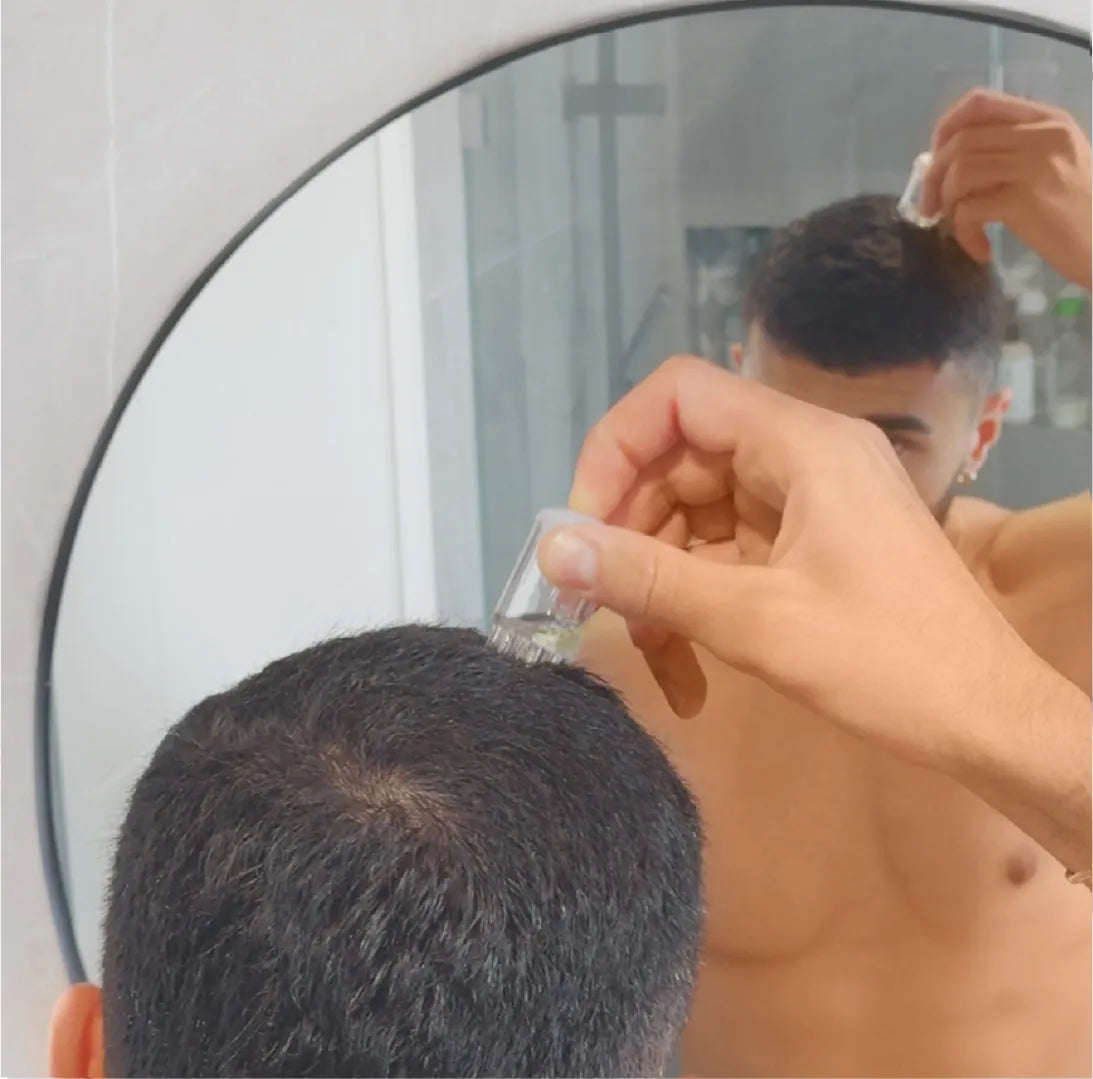
How to Apply Scalp Serum for Diffuse Thinning: Parting Method, Tools, and Zero-Waste Technique
[key_summary summary="Proper scalp serum application uses a methodical parting technique to ensure even coverage directly on the scalp rather than the hair. Most people with diffuse thinning need more product than manufacturers suggest, and using the right tools can dramatically reduce waste while improving results."]
The information in this article is for general education only and is not a substitute for personalised medical advice. Always speak to your GP or healthcare provider before making changes to your medication, supplements or treatment plan.
If you're dealing with diffuse hair thinning, you've probably invested in a quality scalp serum—but are you applying it correctly? Many people unknowingly waste product by letting it sit on their hair rather than reaching the scalp where it's needed most. The difference between haphazard application and a systematic approach can mean the difference between seeing results and feeling frustrated with your investment.
Diffuse thinning affects the entire scalp rather than specific areas, making proper serum application both more challenging and more crucial. Unlike targeted treatments for receding hairlines, serums for diffuse thinning need comprehensive coverage while avoiding waste. Getting this balance right requires understanding both the technique and the tools that make application more effective.
Understanding Diffuse Thinning and Why Application Matters
Diffuse thinning means hair loss is spread across the entire scalp rather than concentrated in specific patterns. This type of hair loss—common in conditions like telogen effluvium, early androgenic alopecia, and postpartum hair changes—requires treatment that reaches every area of the scalp consistently. Clinical guidance from dermatology experts confirms that diffuse thinning involves uniform hair density reduction across the entire scalp, distinguishing it from patterned hair loss.
The challenge lies in the fact that thinning hair often means less obvious parting lines and scalp access. Many people apply serum to what they think is their scalp, but much of the product ends up coating existing hair strands instead. This not only wastes expensive treatments but can also make hair appear greasy or weighed down.
Effective serum application for diffuse thinning focuses on three key principles:
- Direct scalp contact: The active ingredients need to reach hair follicles, not hair shafts
- Even distribution: Patchy application leaves some areas untreated
- Appropriate dosing: Too little won't be effective; too much creates waste and residue
Research shows that topical treatments work best when they penetrate the scalp tissue where hair follicles are located, though the evidence is still emerging on exactly how much surface application interferes with absorption. Studies on follicular absorption suggest that hair follicles provide a significant pathway for treatment penetration, with some research showing up to 10 times higher initial absorption rates compared to surface application.
The Systematic Parting Method
The most effective technique for applying scalp serum involves creating deliberate sections across your entire scalp. This methodical approach ensures comprehensive coverage without guesswork, and hair care experts consistently recommend the parting method as standard best practice.
Step-by-Step Application Process
Start with clean, towel-dried hair that's slightly damp but not soaking wet. Excess water can dilute the serum, while completely dry hair can make parting more difficult. Multiple hair care sources confirm that slightly damp, clean hair provides optimal conditions for serum absorption.
- Create your first section: Use a tail comb or your fingers to create a clean part from your forehead to the back of your neck, dividing your hair in half
- Apply to the central part: Place 2-3 drops of serum directly onto the exposed scalp along this central line
- Spread gently: Use your fingertips to massage the serum into the scalp without pulling it through your hair
- Create parallel sections: Move approximately 2cm to one side and create another part parallel to the first
- Continue systematically: Work from the center outward on both sides, then repeat the process from front to back
[tip tip-title="Work in Good Lighting" tip-text="Apply your serum near a window or under bright bathroom lighting. Being able to clearly see your scalp helps ensure you're applying product where it's needed rather than on existing hair."]
The key is maintaining consistent spacing between parts. Sections that are too far apart leave gaps in coverage, while sections that are too close together create overlap and waste product. Most people find that 1.5-2cm spacing provides optimal coverage for diffuse thinning.
Managing Product Amount
One of the biggest frustrations people experience is determining how much serum to use. Manufacturer recommendations often suggest smaller amounts than what's practically needed for comprehensive scalp coverage, especially with diffuse thinning patterns, though the evidence on this varies between products.
A realistic approach involves using approximately 1ml of serum per application session—roughly equivalent to a full dropper for most products. This might seem like more than suggested on product labels, but diffuse thinning requires broader coverage than localised treatments. However, it's worth noting that dosing recommendations vary significantly between products, with some requiring up to 2ml for optimal coverage.
[quote quote="Most people find they need about twice the amount suggested on the bottle to properly cover their entire scalp. It's better to use an adequate amount less frequently than to under-dose daily applications." author="Hair restoration specialist"]
Consider applying serum every other day or three times per week rather than daily with insufficient amounts. This approach often provides better results while managing product costs more effectively.
Tools That Make a Difference
While you can apply serum with just your hands, the right tools significantly improve precision and reduce waste. The applicator design affects how easily you can access your scalp and control product placement.
| Applicator Type | Best For | Pros | Cons |
|---|---|---|---|
| Standard dropper bottle | Precise placement | Good control, familiar design | Can be slow, requires steady hands |
| Bottles with comb caps | Systematic application | Creates parts automatically, even distribution | May need cleaning between uses |
| Thin nozzle bottles | Direct scalp access | Excellent precision, minimal waste | Can clog with thicker serums |
| Spray bottles | Quick coverage | Fast application | Poor control, much waste on hair |
Many people find that transferring serum to a bottle with a specialized applicator tip improves their results dramatically. Scalp application tools designed specifically for topical treatments can make the parting and application process much more efficient.
DIY Application Tools
If you're working with a standard dropper bottle, you can improve your technique with simple modifications:
- Use a tail comb for creating clean, straight parts
- Apply serum to the comb handle and use it to draw lines along your scalp
- Keep a small mirror handy to check coverage on the back of your head
- Use your non-dominant hand to hold hair sections aside while applying with your dominant hand
[tip tip-title="Try the Tilt Technique" tip-text="Tilt your head to one side when applying serum to that area. Gravity helps the product flow directly onto your scalp rather than running through your hair, reducing waste and improving absorption."]
Zero-Waste Application Strategies
Quality scalp serums represent a significant investment, making efficient application crucial for both results and budget management. Several strategies can help you maximise every drop while maintaining effective coverage.
Timing Your Application
Apply serum when your scalp can best absorb it, typically on clean hair after washing. Expert guidance consistently recommends applying serum to a clean scalp for optimal absorption, as oils and debris can interfere with penetration. However, you don't need to wash your hair every time you apply serum. Many people find success with a routine of washing 2-3 times per week and applying serum after each wash, plus one or two additional serum applications on non-wash days.
The slight dampness remaining after towel-drying actually helps serum distribution. Completely dry scalps can cause serum to sit on the surface, while overly wet hair dilutes the product.
Optimising Absorption
Once you've applied serum using the parting method, gentle massage helps ensure absorption and distribution. Use the pads of your fingers—not your nails—to lightly massage the scalp for 30-60 seconds after application.
Some people enhance absorption by using complementary tools. Scalp stimulation devices can help increase blood flow and potentially improve how well topical treatments penetrate the skin.
[tip tip-title="Don't Rush the Process" tip-text="Set aside 10-15 minutes for proper serum application rather than trying to rush through it. Taking your time ensures better coverage and reduces the likelihood of missing sections or applying too much product in one area."]
Managing Frequency and Amount
Rather than applying small amounts daily, many people achieve better results with more substantial applications every 2-3 days. This approach ensures adequate dosing while allowing time for the scalp to absorb each treatment fully.
Track your usage to understand your personal needs. Most people with diffuse thinning find that a 30ml bottle lasts 4-6 weeks with proper application technique, depending on coverage area and frequency.
Common Application Mistakes to Avoid
Even with good intentions, several common errors can reduce the effectiveness of scalp serum treatments. Understanding these pitfalls helps ensure you're getting the most from your routine.
Surface-Level Application
The most frequent mistake is applying serum to hair rather than scalp. This happens when people don't create proper parts or when they apply product too quickly without ensuring scalp contact. Hair that feels coated or looks greasy after serum application usually indicates this problem.
Inconsistent Coverage Patterns
Random application without systematic sectioning often leaves significant areas untreated. Some people focus too heavily on areas where thinning is most visible, neglecting other regions where prevention is equally important.
Inadequate Massage and Distribution
Simply placing drops on the scalp without gentle massage limits absorption. The serum needs to be worked into the skin slightly, but avoid aggressive rubbing that can irritate sensitive scalps or cause hair shedding.
Wrong Application Timing
Applying serum to dirty or product-heavy hair reduces absorption. Similarly, applying it immediately before heat styling or using heavy conditioners can interfere with how well the treatment penetrates.
[tip tip-title="Start Simple and Build Consistency" tip-text="Begin with a basic parting pattern and focus on consistent application rather than trying to perfect complex techniques immediately. Regularity matters more than perfect technique, especially in the first few weeks."]
Choosing the Right Serum for Your Application Method
Not all scalp serums work equally well with systematic application techniques. The consistency, active ingredients, and formulation affect how easily you can apply the product and how well it absorbs.
Look for serums with moderate viscosity—not so thin that they run everywhere, but not so thick that they're difficult to spread. Water-based formulations often distribute more evenly than oil-heavy products, though individual scalp sensitivity varies.
Quality formulations designed for diffuse thinning, such as advanced growth serums, typically include ingredients that enhance absorption and reduce the likelihood of residue buildup on hair.
Consider your scalp sensitivity when selecting products. Some people with reactive scalps need gentler formulations, while others can handle stronger active ingredients. Starting with a milder product and building tolerance often works better than beginning with maximum-strength formulations.
What the research says about scalp serums for diffuse thinning
Understanding the evidence behind scalp serum application can help set realistic expectations and guide your routine:
- Follicular absorption is significant: Research shows that hair follicles provide an important pathway for topical treatments to penetrate the scalp, with some studies indicating up to 10 times higher absorption rates compared to surface application.
- Application technique matters: Multiple clinical sources confirm that the parting method ensures better product delivery to target areas, though we don't yet know for sure how much surface application interferes with overall effectiveness.
- Dosing varies between products: The evidence is still emerging on optimal dosing, with manufacturer recommendations ranging from 1-2ml per application, and individual needs varying based on scalp size and thinning pattern.
- Clean scalp improves absorption: Studies consistently show better penetration when treatments are applied to clean scalp tissue, though the optimal timing between washing and application continues to be refined.
- Results take time: Clinical guidance indicates that most topical treatments for diffuse thinning require 3-6 months of consistent use before visible improvements become apparent, reflecting natural hair growth cycles.
When to Seek Professional Guidance
While proper application technique can significantly improve your results with scalp serums, some situations benefit from professional assessment and treatment planning.
Consider consulting with a hair restoration specialist if:
- Your thinning is progressing rapidly despite consistent serum use
- You're experiencing scalp irritation or sensitivity with multiple products
- You're unsure whether your hair loss pattern requires additional treatments
- You want to combine topical serums with other therapies like PRP or PRF
Professional treatments can complement at-home serum application. Many people find that combining properly applied topical treatments with periodic in-clinic therapies provides more comprehensive results than either approach alone.
A specialist can also help you determine whether your current serum choice and application routine align with your specific type of hair loss and treatment goals.
Maintaining Long-Term Success
Consistent, proper application becomes easier with practice, but maintaining motivation requires realistic expectations about timelines and results. Most topical treatments for diffuse thinning require 3-6 months of consistent use before significant changes become apparent.
Track your progress with photos taken in consistent lighting rather than relying on day-to-day observations, which can be influenced by styling, lighting, and natural hair growth cycles. Monthly photos from the same angles help provide objective feedback about your routine's effectiveness.
Remember that scalp health and hair growth respond to multiple factors beyond topical treatments. Adequate nutrition, stress management, and addressing any underlying health conditions all contribute to the success of your serum application routine.
Consider tools that support your application routine, such as scalp massage devices that can enhance circulation and potentially improve treatment absorption.
FAQ
How much serum should I actually use for diffuse thinning coverage?
Most people need about 1ml of serum per application to properly cover their entire scalp with diffuse thinning. This is often more than manufacturer suggestions, but comprehensive coverage requires adequate product. It's better to use sufficient amounts every other day than to under-dose with daily applications.
Can I apply scalp serum to wet hair, or should it be completely dry?
Slightly damp, towel-dried hair is actually ideal for serum application. Complete dryness can make the product sit on the surface, while excessive wetness dilutes the serum. Hair should feel damp to touch but not be dripping wet when you apply treatment.
Why does my hair look greasy after applying serum, even when I follow the instructions?
Greasy appearance usually means the serum is coating your hair rather than reaching your scalp. Focus on creating cleaner parts, applying smaller amounts per section, and ensuring you're placing drops directly on visible scalp rather than on existing hair strands.
How long should I wait to see results from proper serum application?
Most people notice initial changes in scalp health within 4-6 weeks, but visible hair density improvements typically take 3-6 months of consistent application. Hair growth cycles are naturally slow, so patience with proper technique is essential for evaluating effectiveness.
Should I massage my scalp after applying serum, and for how long?
Yes, gentle massage for 30-60 seconds after application helps distribute the serum and may improve absorption. Use your fingertips rather than nails, and avoid aggressive rubbing that could irritate your scalp or cause unnecessary hair shedding during the process.
